Cable, Wire & Extensions

5 products

Showing 1 - 5 of 5 products

Showing 1 - 5 of 5 products
View

Cable, Wire & Extensions FAQ

Thermocouple grade wire and extension grade wire serve similar purposes but differ in accuracy and application. Thermocouple grade wire is made from the same materials as the thermocouple sensor itself and is used in the sensing junction, where precise temperature measurement is critical. Extension grade wire, on the other hand, is designed to carry the thermoelectric signal from the sensor to the measuring instrument. It uses similar but less costly materials and is accurate over a limited temperature range, typically lower than that of thermocouple grade wire.

Thermocouple IEC and ANSI colour codes differ mainly in how they identify thermocouple types and polarity. IEC standards (used in Europe and many other regions) assign specific colours to both the thermocouple type and the positive/negative wires, often using brown as a base colour. ANSI standards (commonly used in North America) use a different colour scheme, where each thermocouple type has a distinct overall colour and red typically indicates the negative wire. Because the colours are not interchangeable, using the wrong standard can lead to miswiring, inaccurate readings, or equipment damage, so it’s important to verify the correct code before installation.

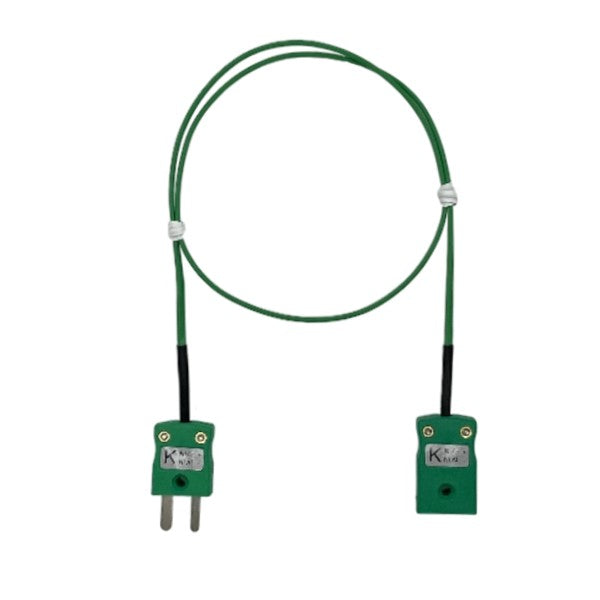
The main difference between a standard and a miniature thermocouple connector lies in their size, design, and typical applications. Standard thermocouple connectors are larger, have round pins, more robust, and often used in industrial settings where durability and secure connections are critical. Their size makes them easier to handle, especially when wearing gloves or working in environments where quick and reliable connections are needed.

Miniature thermocouple connectors, on the other hand, are smaller, have flat blades and more compact. They are often used in laboratory, testing, or research applications where space is limited, and multiple connections may be required in a confined area. Despite their smaller size, they provide the same accuracy and functionality as standard connectors.

Both connector types are available in various thermocouple materials and polarities, ensuring compatibility with different thermocouple types. The choice between standard and miniature connectors generally depends on the space available, the environment, and the ease of handling required.

Thermocouples come in various types, classified by the combination of metals used and their temperature ranges, sensitivities, and applications. The most common types include Type K, J, T, E, N, R, S, and B.

Type K (Nickel-Chromium/Nickel-Alumel) is the most widely used, suitable for general-purpose use up to about 1300°C. Type J (Iron/Constantan) works well in lower temperatures (up to 750°C) but oxidizes quickly in moist atmospheres. Type T (Copper/Constantan) offers excellent accuracy at low temperatures,  and they are often used for cryogenic applications. Type E (Chromel/Constantan) provides a stronger signal and is good for low-temperature applications. Type N (Nicrosil/Nisil) is stable and accurate at high temperatures, making it suitable for industrial use.

For high-temperature applications, Type R, S and B (all using platinum alloys) are used. These types are often used in laboratories or in the metal processing industries.

Recently viewed